
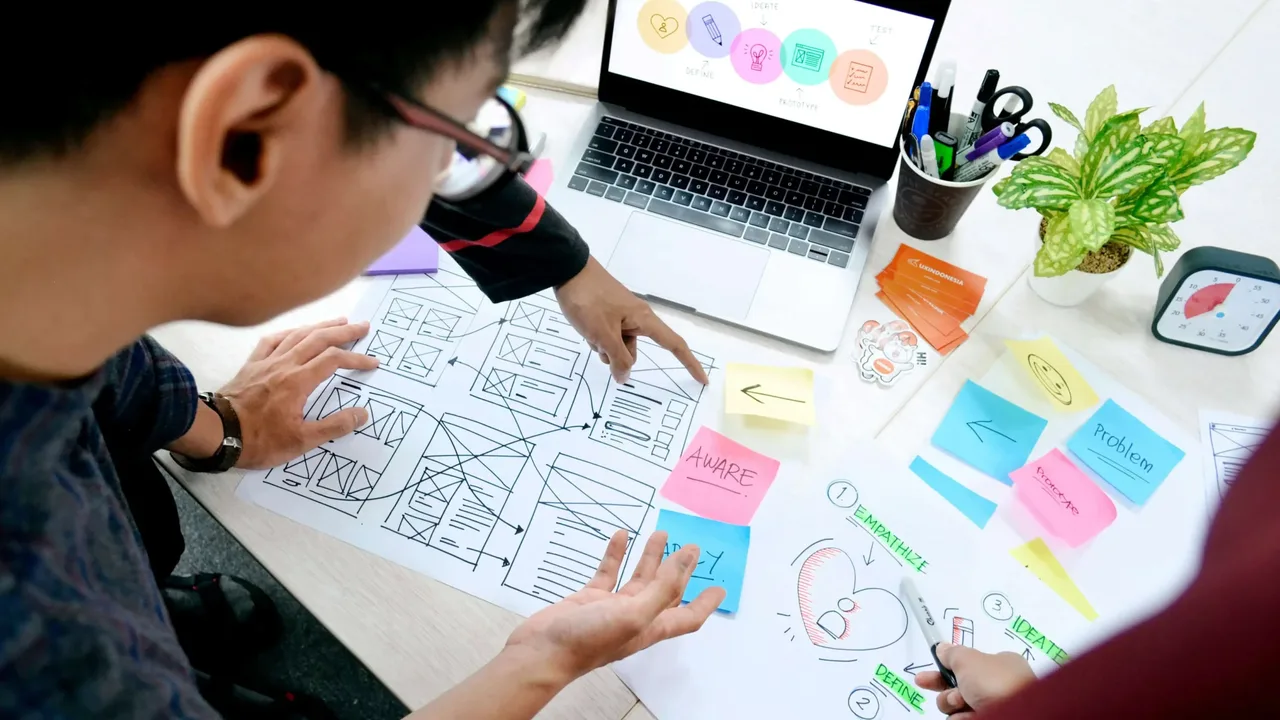
In today’s fast-moving markets, innovation is no longer a luxury—it is a requirement for survival. Companies across industries face constant pressure from changing customer expectations, digital disruption, and global competition. Yet despite heavy investments in technology and talent, many organizations still struggle to innovate in meaningful ways. This is where design thinking business practices are increasingly reshaping how companies approach growth, strategy, and problem solving.
Rather than relying on rigid planning or intuition alone, design thinking introduces a structured yet flexible way to explore uncertainty. It helps businesses move from assumptions to insights, from ideas to experiments, and from incremental improvements to real innovation.
Introduction — Why Innovation Is No Longer Optional
Traditional business models were built for stable environments. Long planning cycles, predictable customer behavior, and linear execution once worked well. Today, those conditions rarely exist. Markets evolve faster than annual strategies, and customer needs shift before products even launch.
In this context, innovation fails not because teams lack ideas, but because they lack a reliable way to explore complex problems. Design thinking fills this gap by offering a human-centered approach that aligns creativity with execution. Within a design thinking business framework, innovation becomes a repeatable capability rather than a one-time breakthrough.
What Is Design Thinking in a Business Context?
Beyond Design — A Mindset for Problem Solving
Despite its name, design thinking is not about aesthetics or visual design. In business, it functions as a mindset for tackling ambiguity and complexity. At its core, design thinking focuses on understanding real human needs and translating those insights into practical solutions.
Many organizations jump straight to solutions—new features, new products, new campaigns—without clearly defining the problem. Design thinking reverses this logic. It begins with observation and empathy, ensuring that teams solve the right problem before investing resources. This approach strengthens problem solving by grounding decisions in evidence rather than assumptions.
The Core Principles of Design Thinking
While implementations vary, most design thinking approaches share several foundational principles that make them effective in business environments:
- Empathy: Deeply understanding users, customers, and stakeholders.
- Exploration: Expanding possible solutions before narrowing choices.
- Experimentation: Learning through prototypes instead of predictions.
- Iteration: Refining ideas based on feedback and real-world testing.
- Integration: Aligning creativity with operational and commercial realities.
Together, these principles transform innovation from a risky leap into a guided process.
The Design Thinking Process Explained
Empathize — Understanding the Real Problem
The first stage of design thinking focuses on empathy. In business terms, this means going beyond market data and listening directly to users. Interviews, observations, and contextual research help uncover unmet needs that surveys often miss.
For example, a declining product may not fail due to price or quality, but because it no longer fits how customers work or live. Empathy reveals these hidden insights, enabling teams to redefine challenges accurately. Without this step, innovation efforts often target symptoms rather than root causes.
Define — Framing the Right Challenge
Once insights are gathered, the next step is synthesis. Teams translate observations into clear problem statements that guide ideation. This phase is critical in design thinking business applications because it aligns stakeholders around a shared understanding of the challenge.
A well-defined problem is neither too broad nor too narrow. It creates focus without limiting creativity, providing a strong foundation for the creative process that follows.
Ideate — Expanding Possibilities
Ideation encourages teams to generate a wide range of solutions before selecting one. In contrast to traditional meetings that favor safe ideas, design thinking values diversity and quantity at this stage. Wild ideas are welcomed because they often spark unexpected breakthroughs.
This phase reframes creativity as a collective activity rather than an individual talent. Cross-functional teams—combining marketing, operations, engineering, and leadership—produce richer outcomes by bringing multiple perspectives into the process.
Prototype and Test — Learning Through Action
Instead of waiting for perfect plans, design thinking promotes rapid prototyping. A prototype can be anything from a sketch or mockup to a pilot service or internal simulation. The goal is not polish, but learning.
Testing prototypes with real users reveals what works and what doesn’t—early and cheaply. This approach reduces risk by replacing long debates with evidence. Over time, organizations develop confidence in experimentation, making innovation faster and more resilient.
How Design Thinking Drives Business Innovation
Turning Uncertainty into Structured Exploration
Innovation inherently involves uncertainty. Markets shift, technologies evolve, and customer behavior changes in unpredictable ways. Design thinking does not eliminate uncertainty, but it structures how businesses explore it.
By breaking large challenges into smaller experiments, companies can move forward without committing fully to untested ideas. This structured exploration enables smarter investment decisions and strengthens the link between creativity and execution.
From Incremental Improvement to Breakthrough Ideas
Many organizations focus on incremental optimization—slightly better processes, marginally improved features. While valuable, this mindset rarely produces transformative innovation. Design thinking opens space for reframing problems entirely, leading to new products, services, or business models.
Within a design thinking business environment, innovation is not limited to R&D teams. It becomes a shared capability that influences strategy, operations, and customer experience alike.
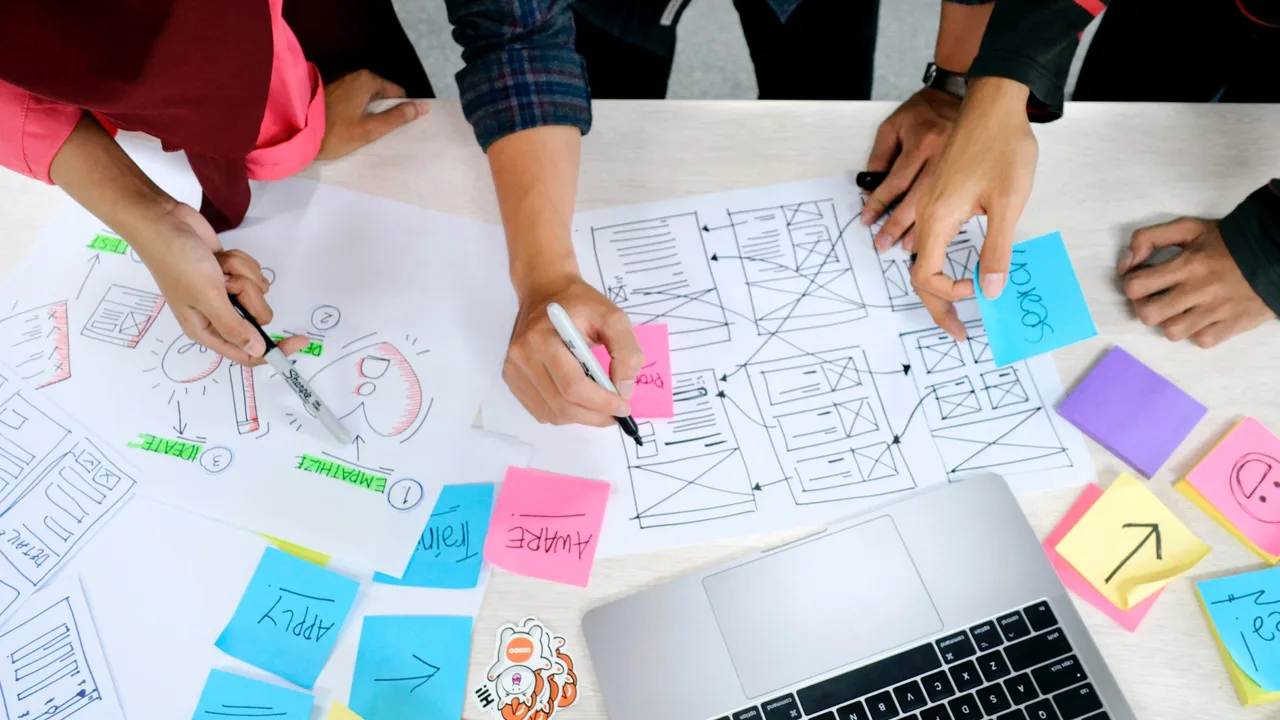
Design Thinking vs Traditional Business Planning
Why Linear Thinking Fails in Complex Problems
Conventional business planning often assumes that problems are predictable and solutions can be mapped in advance. This linear logic works well in stable environments, but it struggles when uncertainty is high. Customer behavior, technology adoption, and competitive landscapes rarely follow neat sequences anymore.
In contrast, design thinking business approaches accept ambiguity as a starting point. Instead of forcing clarity too early, teams explore assumptions through observation and testing. This shift is especially powerful when dealing with complex challenges where the problem itself is not fully understood at the outset.
Creative Process vs Rigid Execution
Traditional execution models reward efficiency and control, often discouraging deviation from plan. While this mindset reduces short-term risk, it also limits learning. Design thinking reframes execution as an adaptive process, where feedback continuously informs direction.
The creative process in design thinking does not replace discipline—it complements it. Structure still exists, but it is flexible enough to evolve as insights emerge. Businesses that adopt this balance tend to respond faster to change without losing strategic focus.
Real-World Applications Across Industries
Product and Service Innovation
Many successful products begin not with technology, but with a deep understanding of user pain points. Design thinking enables teams to identify unmet needs and prototype solutions quickly. This approach reduces the likelihood of launching products that look impressive but fail to resonate in real use.
By testing early concepts with users, organizations can validate demand before committing to full-scale development. This makes innovation more efficient and aligns investment with real value creation.
Organizational and Process Innovation
Innovation is not limited to external offerings. Internal processes, workflows, and organizational structures also benefit from design thinking. Teams can redesign onboarding experiences, decision-making systems, or collaboration tools by applying the same empathy-driven logic used for customers.
When employees feel heard and involved in shaping solutions, engagement increases. This cultural impact often becomes one of the most lasting benefits of a design thinking business mindset.
Customer Experience and Brand Strategy
Customer experience is where design thinking delivers visible impact. From digital platforms to physical touchpoints, mapping customer journeys helps businesses identify friction points and emotional drivers. These insights inform not just service improvements, but brand positioning and communication strategies.
Rather than guessing what customers value, companies observe and test. Over time, this leads to more authentic brand relationships built on trust and relevance.
Common Misconceptions About Design Thinking
“Design Thinking Is Only for Designers”
One of the most persistent myths is that design thinking belongs exclusively to creative departments. In reality, its strength lies in cross-functional collaboration. Finance teams use it to redesign pricing models, operations teams apply it to logistics challenges, and leaders rely on it to explore strategic direction.
Because it centers on problem solving rather than aesthetics, design thinking is accessible to anyone willing to engage with uncertainty and experimentation.
“It’s Too Soft for Serious Business”
Another misconception is that design thinking lacks rigor. While the language of empathy and creativity may sound abstract, the outcomes are concrete. Prototypes, user feedback, and measurable experiments provide real data for decision-making.
In fact, many global organizations have formalized design thinking as part of their innovation systems, recognizing that intuition alone is insufficient in complex markets.
Building a Design Thinking Culture in Business
Leadership and Psychological Safety
Culture determines whether design thinking thrives or fails. Leaders play a crucial role by creating psychological safety—an environment where teams feel comfortable sharing ideas, questioning assumptions, and learning from failure.
Without this support, design thinking risks becoming a one-off workshop rather than a sustained capability. Leadership commitment signals that experimentation is valued, even when outcomes are uncertain.
From Workshops to Daily Practice
Many organizations are introduced to design thinking through short workshops. While useful, these sessions alone rarely create lasting change. The real impact comes when design thinking principles are embedded into daily routines—project planning, reviews, and strategic discussions.
Over time, teams internalize the mindset. Asking better questions becomes habitual, and innovation shifts from an occasional initiative to an ongoing practice.
The Future of Design Thinking in Business Innovation
As artificial intelligence and automation reshape industries, human-centered thinking becomes even more valuable. Algorithms excel at optimization, but they struggle to understand context, emotion, and meaning. Design thinking fills this gap by ensuring that innovation remains grounded in human needs.
Research and educational institutions continue to refine design thinking frameworks, emphasizing evidence-based experimentation and ethical responsibility, as discussed in foundational work from organizations like IDEO U. This evolution reinforces design thinking as a strategic capability rather than a creative trend.
Conclusion — Innovation Starts with Better Questions
Innovation does not begin with answers—it begins with questions. Design thinking business practices empower organizations to ask better questions about customers, systems, and opportunities. By combining empathy with experimentation, companies transform uncertainty into insight.
In a world defined by constant change, the ability to learn quickly is a competitive advantage. Design thinking does not guarantee success, but it builds the conditions for sustainable innovation. For businesses willing to embrace curiosity and adaptability, it offers a practical path forward.